Collision (Collision / Particle collision) is a technical term that is extremely important in the rendering and optimization of game graphics (technical art). A processing system that determines when a particle physically intersects or contacts an obstacle or collider in 3D space, and provides dynamic behavior such as bouncing, sliding, friction, or annihilation.
An analogy in the real world: A falling super ball gains elasticity the moment it hits the floor (collider) and ``bounces''.
Collision is a physical reflection that ``bounces''. At the moment a scattering super ball (particle) collides with a wall or floor (obstacle), the collision angle and speed are calculated, and the reflection calculation uses elastic force (bounce) to physically bounce it back in the correct direction.'' Without this process, the entire world would become a space where ghosts slip through. The moment a collision is detected, the ball's traveling vector is reversed and friction is applied to cause it to roll, creating a ``realistic material interference relationship'' between the effect and the 3D background.
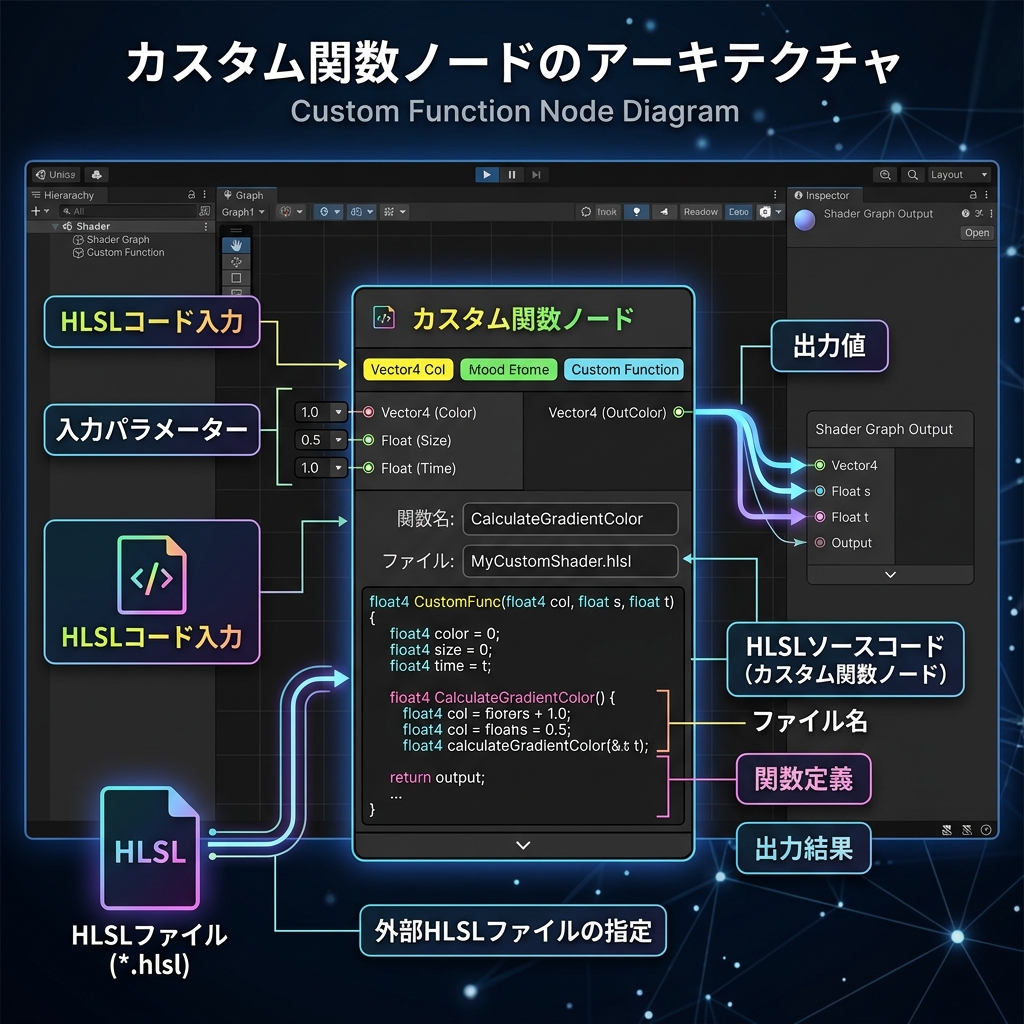
Illustration: Collision (Collision / Infographic that clearly illustrates the basic processing flow and mechanism of particle collision) in Japanese notation
Detailed mechanism and operating principle
Enable the Collision module, specify the world's 3D collider or the GPU's depth map (Depth Buffer) as the collision detection source, and set the Bounce and damping to simulate contact behavior.