Parallax Mapping (Parallax Mapping / height map reflection) is a technical term that is extremely important in the rendering and optimization of game graphics (technical art). In order to express an amazing three-dimensional effect that exceeds the normal map, this article describes a technique that uses height maps (height information) to calculate ``occlusion and deviation due to unevenness'' from the angle of the camera's line of sight, and creates the illusion of deep grooves and three-dimensional sculptures in completely flat polygons.
Real-world analogy: When you look diagonally into a room through a gap in a window, depending on the angle, ``furniture in the back may appear or disappear'' - a trompe l'oeil effect of parallax occlusion
Parallax mapping is a ultra-dimensional, ultra-advanced trompe l'oeil technique in which, even though it is a picture (texture) drawn on a completely flat piece of paper, when you look at it from an angle, the ``uneven back surface'' appears to wrap around according to the angle of the camera, and the pattern shifts so that the edges in the foreground physically hide the grooves in the back.'' Although the number of vertices remains ``4'' (just a square board), it creates an illusion of overwhelming real three-dimensionality and realism to the eye, as if there really were 10cm deep brick grooves.
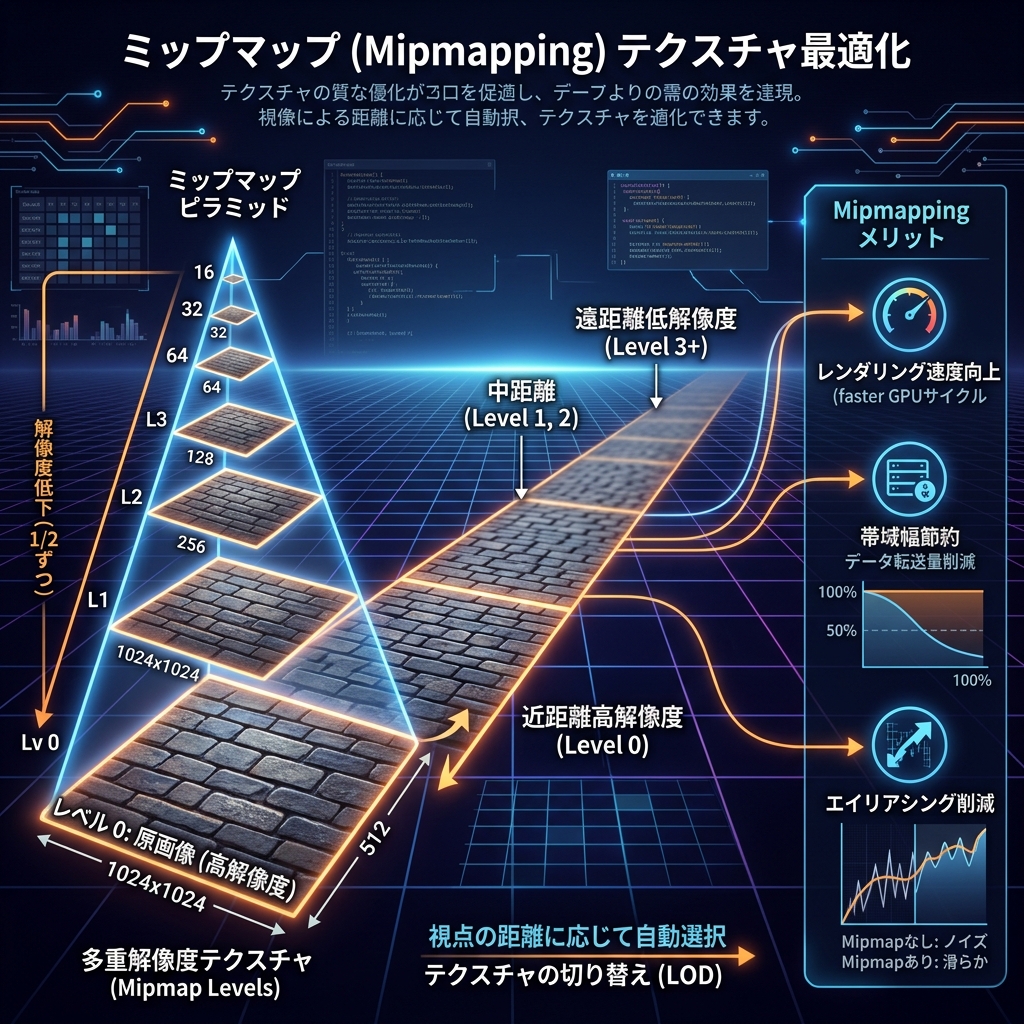
Illustration: Parallax Mapping (Parallax Mapping / Infographic that clearly illustrates the basic processing flow and mechanism of height map reflection) in Japanese.
Detailed mechanism and operating principle
Prepare a black and white height image (Height Map), and use the shader to sample the UV coordinates of the texture in the depth direction based on the camera's view vector (angle of line of sight).