Custom Interpolator (Custom Interpolator) is a technical term that is extremely important in rendering and optimizing game graphics (technical art). Explanation of the data transmission route for safely transmitting custom calculated values for each vertex (normal, arbitrary distance, noise, etc.) from the vertex shader to the fragment shader via linear interpolation between pixels.
Real-world analogy: A cable line in which a ``dedicated data delivery cable (interpolator)'' is stretched tightly between the mountaintop (apex) and the city at the foot (pixel), and data is delivered to the foot of the mountain while automatically calculating the gradation value of the slope along the way
Custom interpolator is ``a dedicated data pipeline between vertices and pixels that smoothly flows various numerical values calculated at the ``corner vertices'' of a 3D model into the ``fill pixels'' while automatically applying an intermediate gradation (linear interpolation)''. The number of vertices is overwhelmingly smaller than the number of pixels, so by performing heavy calculations (e.g. sine waves at local positions) only once on the ``vertex side'' and sending them to this pipeline, the pixel side can ``just use the received gradation values as they are'', dramatically reducing the pixel load on the GPU.
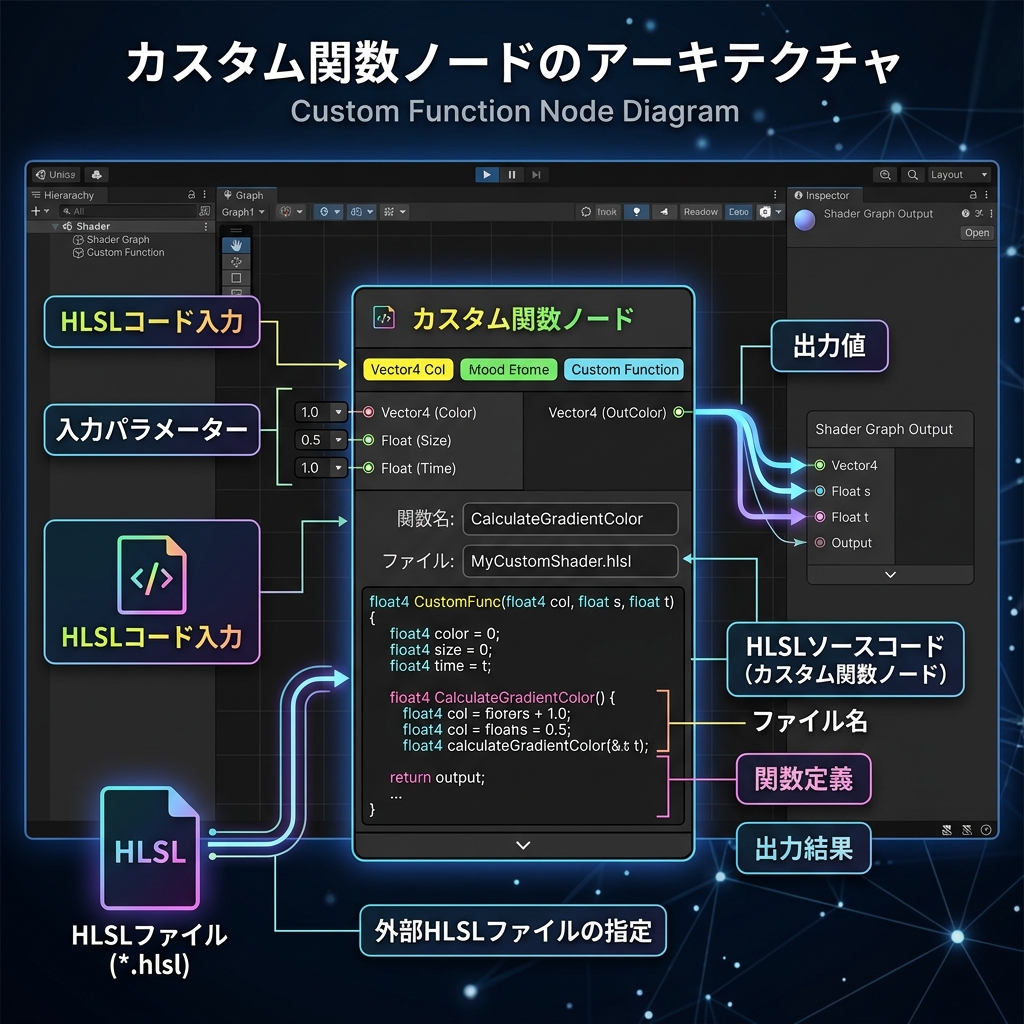
Graph: Custom Interpolator (Infographic that clearly illustrates the basic processing flow and mechanism of custom interpolator) in Japanese notation
Detailed mechanism and operating principle
Add "Custom Interpolator" from the Shader Graph master stack settings, connect the floating point (Float4, etc.) output by the Vertex stage, and receive it as a custom value automatically interpolated by the Fragment stage.