Emission (Self-luminous / Emission) is a technical term that is extremely important in the rendering and optimization of game graphics (technical art). A material setting in which the object itself emits light, like a light bulb or neon, and when combined with HDR settings and the Bloom effect, it creates a beautiful glow in the dark.
Real-world analogy: Behind the scenes of a play, the back of the letters on a prop signboard is hollowed out and a ``real LED light bulb (Emission)'' is placed in it, and the switch is turned on during the night scene to create a dazzling illumination
Emission is a self-assertive light system in which a specific pixel of an object continues to emit light energy values, asserting itself as ``I am the sun or a neon light bulb,'' ignoring any light from the outside.'' By giving this value a strong HDR energy exceeding 1.0 (e.g. brightness 10), the light will be diffusely reflected inside the camera lens, and a ``gentle and beautiful aura of light (Bloom)'' will leak out into the surrounding darkness, transforming it into a real neon that ``actually has electricity inside and shines brightly.''
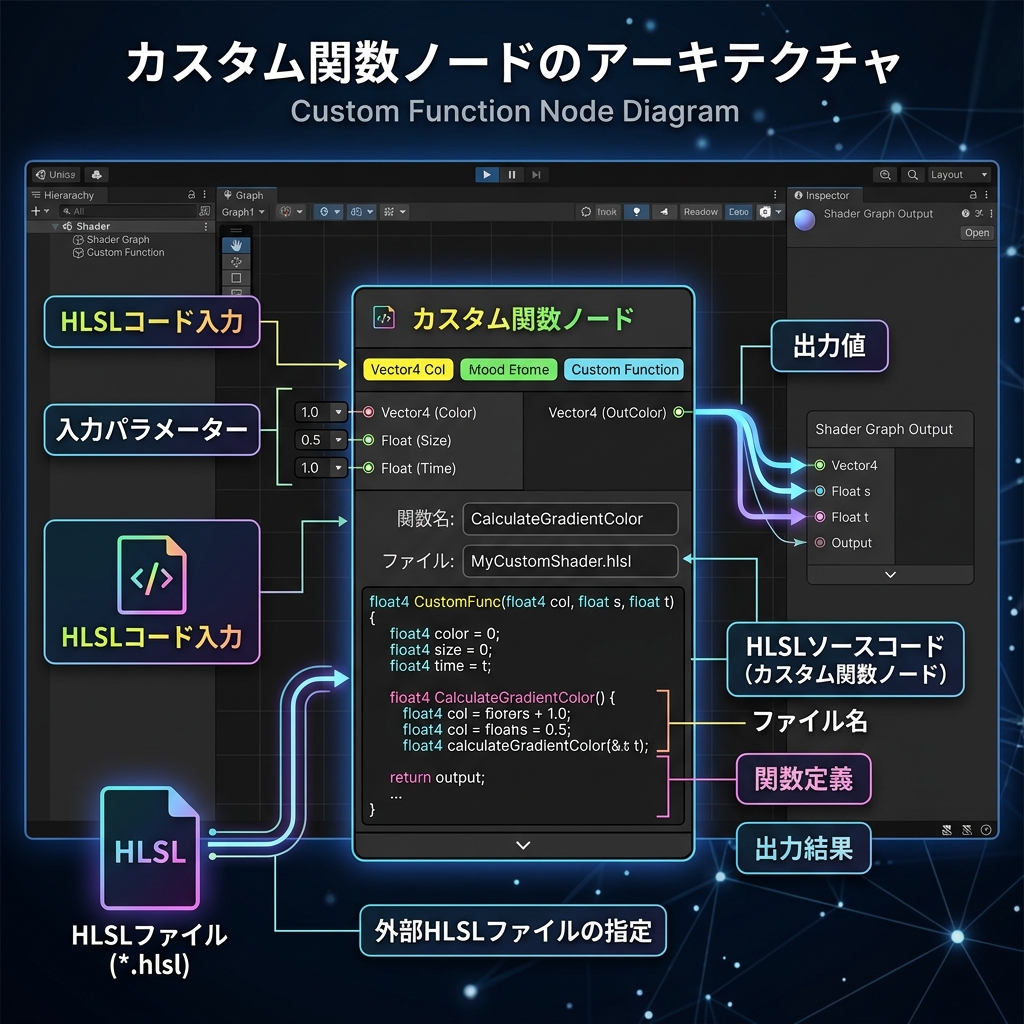
Illustration: Emission (Self-luminous / Emission) Infographic that clearly illustrates the basic processing flow and mechanism in Japanese notation
Detailed mechanism and operating principle
Connect the texture and numerical value of the color you want to glow to the "Emission" slot of the material or Shader Graph, set the HDR intensity (Intensity) to a value of 1.0 or more such as "+2", and set the "Post Processing" href="/article/term-bloom">Bloom' allows light to leak into the surrounding area.