Ambient Occlusion (AO) is a technical term that is extremely important in rendering and optimizing game graphics (technical art). A technology that creates ``occlusion'' shadows of physical indirect light in real time in minute gaps where light cannot reach, the depths of recesses, or joints between objects, giving the world an outstanding sense of three-dimensionality and grounding.
Real world analogy: Reproduction of the phenomenon in which dust and light that cannot reach are accumulated on the ``edges'' of a white wall in a room or on the ``ground contact surface'' of the feet of a desk, causing ``slow black shadows'' to naturally sink
Ambient Occlusion (AO) is a technology that reproduces the atmosphere of thick shadows that slowly sink into ``physically narrow dead ends'' where a beam of light cannot go around, such as the tiny gap between a desk and a wall, the back of a drawer, or the bottom of wrinkles in clothes, no matter how bright the room is.'' Just by adding this ``shadow in the gap'', objects placed on the ground will suddenly have a tremendous ``heaviness'' (feeling of grounding), the cheapness of the CG will disappear in an instant, and the three-dimensional details of the buildings and characters' faces in the world will become overwhelmingly more attractive.
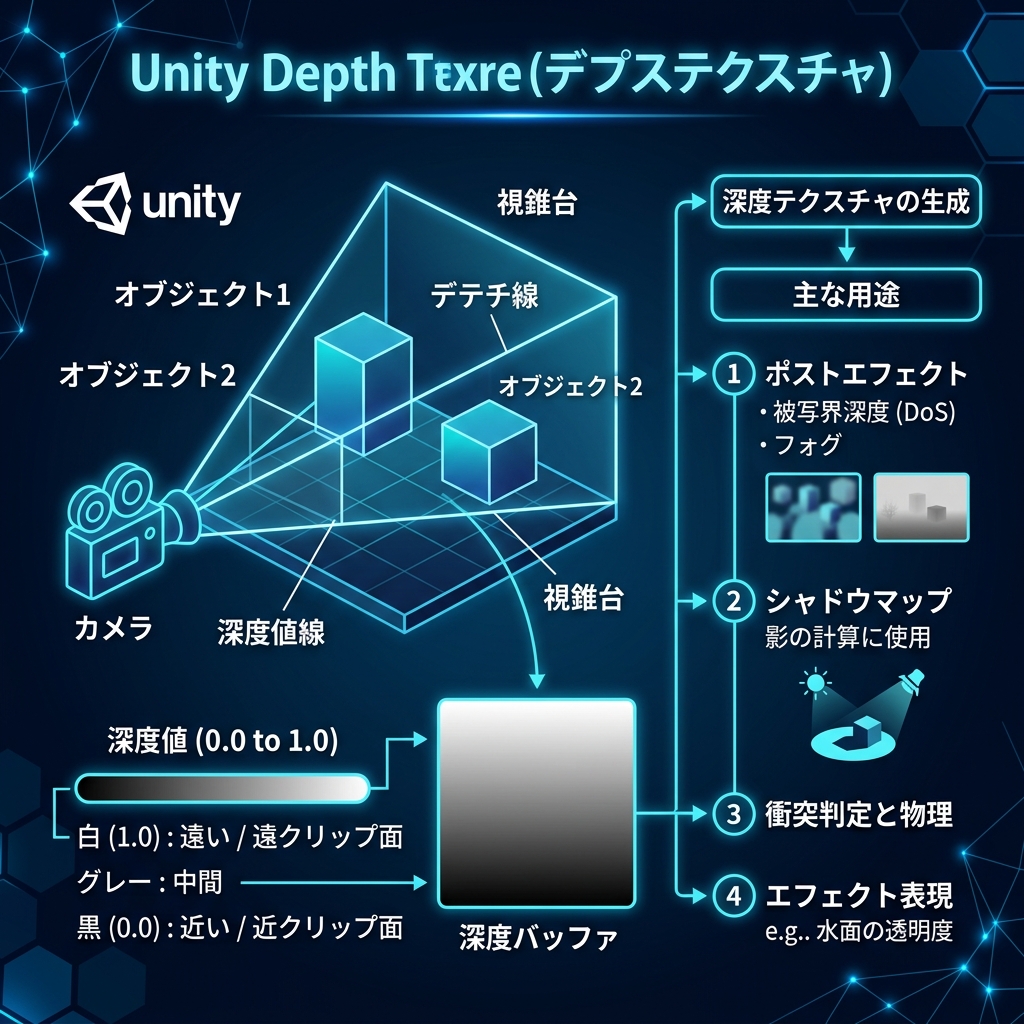
Figure: Infographic that clearly illustrates the basic processing flow and mechanism of Ambient Occlusion (Ambient Occlusion / AO) in Japanese notation
Detailed mechanism and operating principle
Post Processing, or Renderer Feature with "Screen Space Ambient Occlusion (SSAO)" is added, and the "gap shadow (dark area)" in pixel units is instantly calculated and composited from the depth and normal buffer.