Fixed Foveated Rendering (FFR) is a crucial graphics optimization technique for maximizing the hardware performance of VR devices. This technology takes advantage of the fact that the human retina can only perceive high resolution in the central part of the visual field (fovea), and the ability to perceive resolution in the peripheral visual field is extremely low.
Real-world analogy: driver's field of view and windshield antifouling cleaning
The operation of FFR can be compared to "saving the driver's field of view and windshield antifouling cleaning range".
- Conventional (no FFR): While driving, the driver always stares only at the narrow central safety area (central vision) of the windshield, and almost never looks at either side of the glass or the four corners at the top (peripheral vision). However, conventional systems waste a huge amount of washer fluid and electricity (GPU load) in order to clean the entire surface of the glass 100% evenly, causing the engine (GPU) to overheat.
- With FFR: The cleaning level (resolution) is significantly lowered and corners are cut on the "both edges of the glass and the four corners at the top" where drivers don't stare anyway, and all resources (GPU processing power) are concentrated only on the "central area" where the driver's line of sight is concentrated. This results in huge energy savings (reduced GPU load) without the driver even noticing.
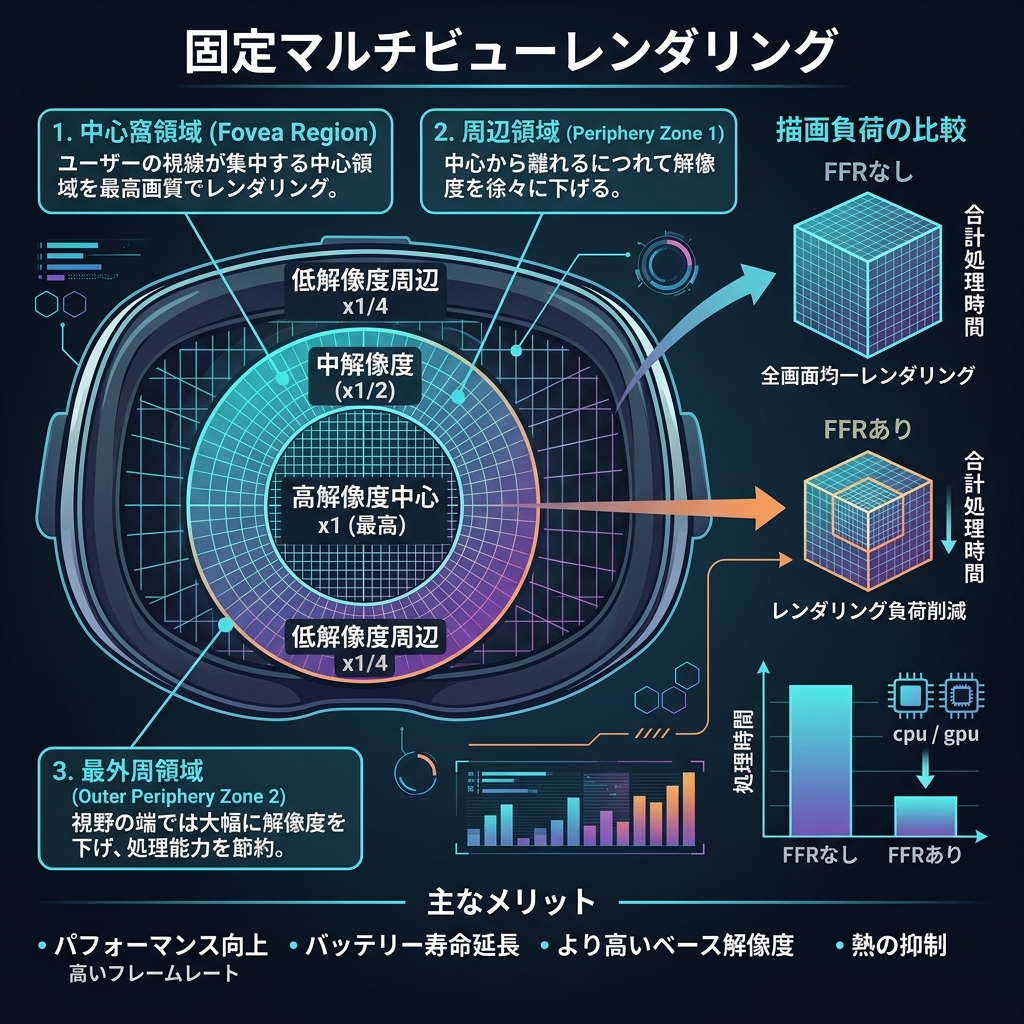
Figure: FFR drawing control image that changes the resolution step from the center of the field of view to the periphery
Mechanism of FFR
When FFR is enabled, the GPU The center area of the field of view is clearly rendered at the requested 100% resolution, but as you move toward the outside of the field of view from 45 degrees to 90 degrees, the resolution is gradually reduced by thinning out 4x4 pixels as 1 pixel. This reduces the processing load on pixel shaders by up to 15-30%, freeing up GPU resources for post-effects, complex shaders, and physics.