Frame Buffer (Frame Buffer) is a technical term that is extremely important in rendering and optimizing game graphics (technical art). An explanation of the top-level memory buffer on the GPU that temporarily holds one frame's worth of color data (red, green, blue, alpha values) that is ultimately output to the display.
Real-world analogy: Instead of showing customers how to draw on a blackboard, you can ``complete it on the blackboard in the back, then quickly turn it around and show it to customers.'' A two-sided blackboard board
Frame buffer is "a 'blackboard for final output' that temporarily stores completed illustrations to be displayed on the TV screen". Modern GPUs do not directly redraw the blackboard (front buffer) that the customer is looking at. After completing all renderings on a back buffer that is invisible to the customer, the blackboard can be rotated (flip/swap) in an instant to completely hide the unsightly intermediate state that is in progress.
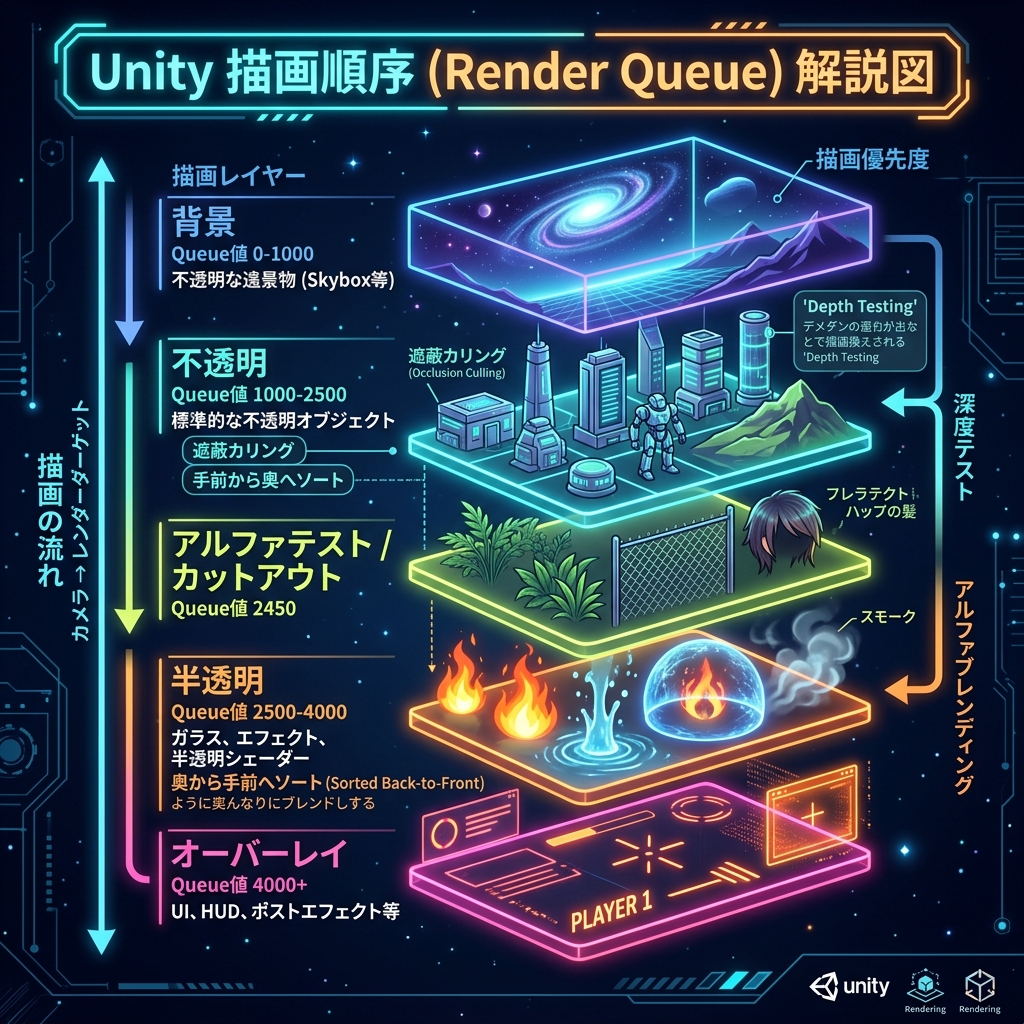
Illustration: Frame Buffer (Infographic that clearly illustrates the basic processing flow and mechanism of frame buffer) in Japanese notation
Detailed mechanism and operating principle
By enabling vertical synchronization (V-Sync) or by using double buffering (two-sided configuration of front buffer and back buffer), only the completely rewritten picture can be flipped (switched) and output.