Multi-Sample Anti-Aliasing (MSAA / Multi-Sample Anti-Aliasing) is a technical term that is extremely important in rendering and optimizing game graphics (technical art). An explanation of the most recommended anti-aliasing method for VR and mobile, which utilizes GPU hardware capabilities to partially sample only the pixels of the contour (edge) of an object's polygons at several times the normal resolution and blend them smoothly.
Real-world analogy: Edge correction for the edge of a diagonal signboard with jagged borders, by temporarily dividing only the squares (pixels) of the border into "4x finer squares (4x multi-samples)" and repainting the color smoothly
MSAA (Multi-Sample Anti-Aliasing) This is a pinpoint contour correction system that detects only the pixels that fall on the ``edge'' of the image, divides the inside of the edge into 4 (4x) or 8 (8x), samples the color finely, and smoothly blends the color with the adjacent color in a gradation. The hardware (GPU) handles the calculations completely automatically, and since it does not increase sampling at all on wide flat surfaces within the screen (inside polygons), it is incredibly light and eliminates only the jagged edges without a trace. Therefore, it is an absolutely recommended setting as a "global standard" in VR development where delays are unacceptable.
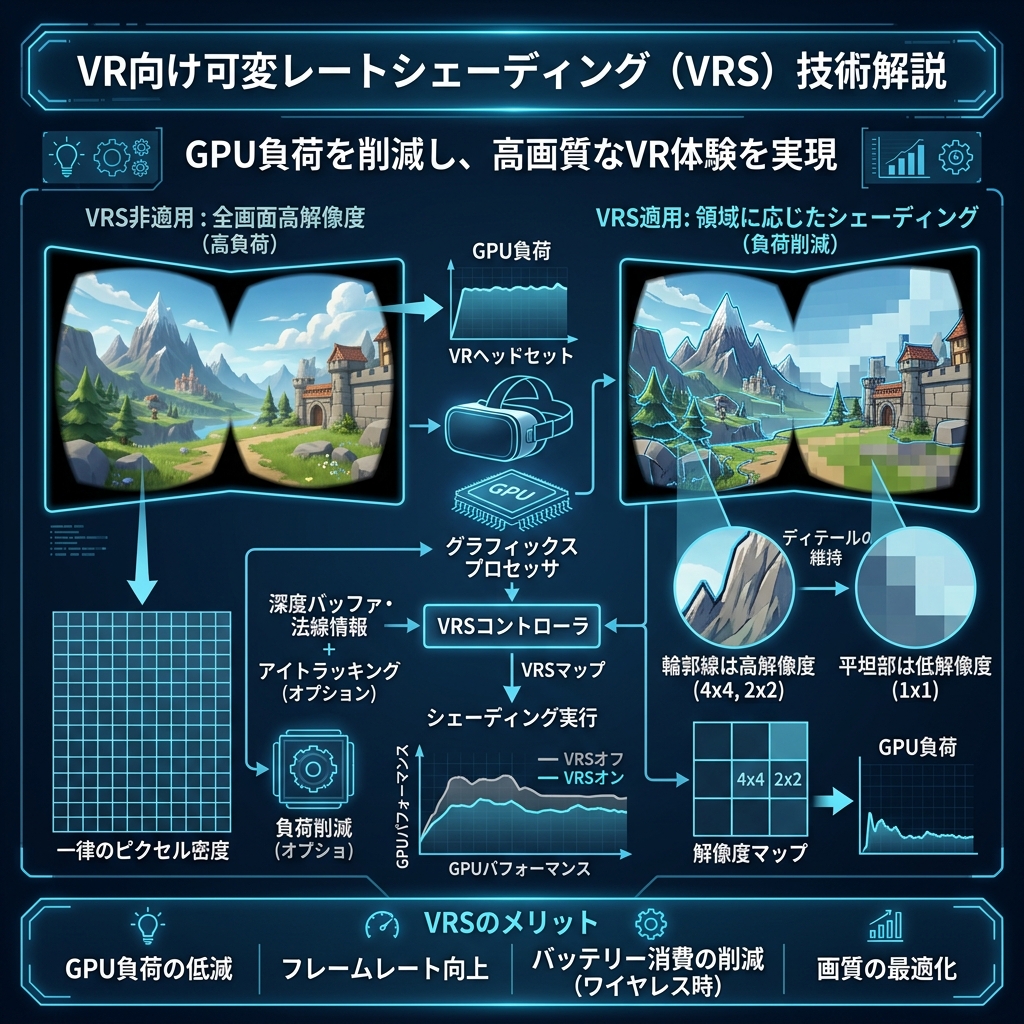
Illustration: Multi-Sample Anti-Aliasing (MSAA / Infographic that clearly illustrates the basic processing flow and mechanism of multi-sample anti-aliasing in Japanese.
Detailed mechanism and operating principle
Enable ultra-fast hardware interpolation of contours by setting the Quality setting of the URP configuration asset used and the camera's "Anti-aliasing (MSAA)" to "4x" or "8x".