Texture Streaming is a technical term that is extremely important in rendering and optimizing game graphics (technical art). Unity's standard memory optimization system dynamically loads only the Mipmap level of the resolution required for the current camera field of view and distance into VRAM (video memory), dramatically reducing memory consumption.
Real-world analogy: Instead of unfolding a thick 1000-page album (all textures at maximum resolution) and placing it on your desk, you can flip through only the ``1 page (required mipmap)'' and spread it on your desk
The system constantly monitors the distance and line of sight from the camera, and stores only the lightweight "child images (256 size data)" in memory without loading the "heavy parent images (4K data)" of assets that are far away, dramatically reducing VRAM consumption by up to more than half without degrading image quality by even 1 mm.
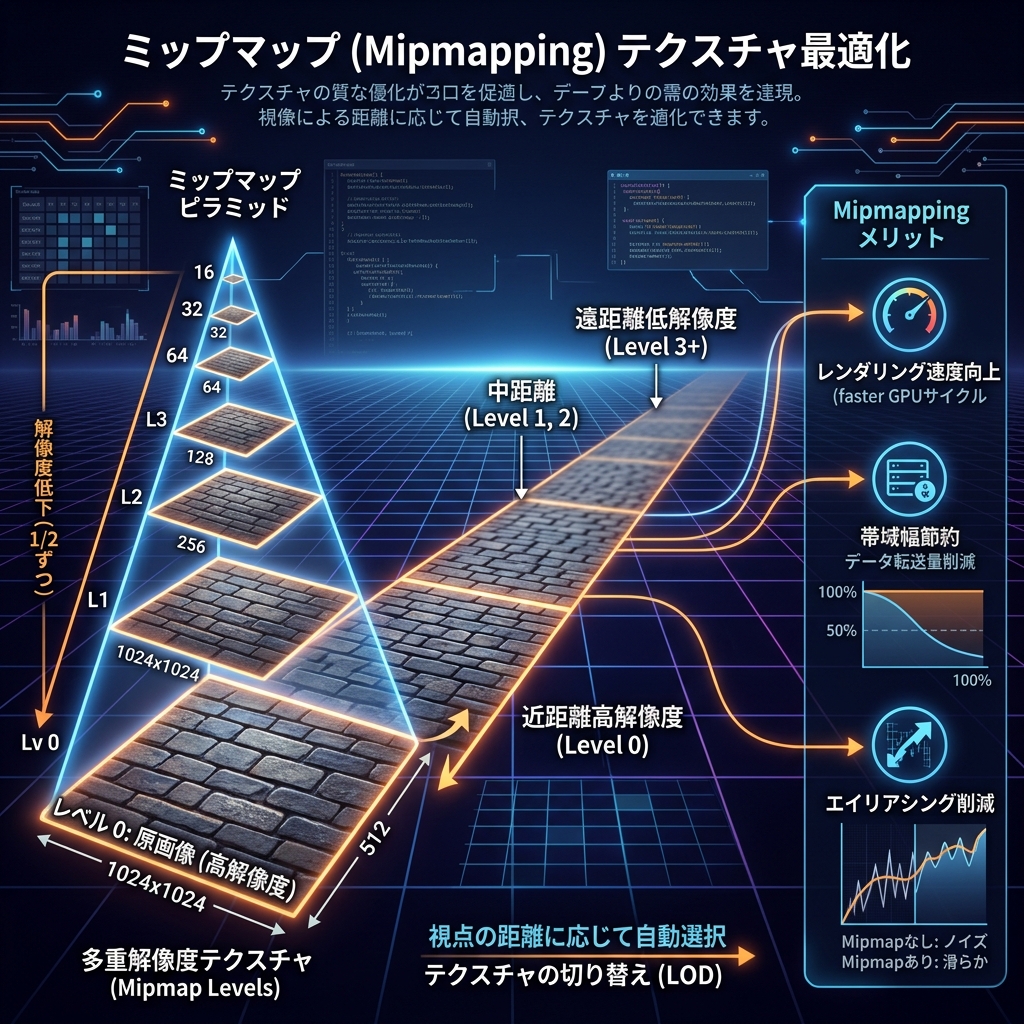
Figure: Infographic that clearly illustrates the basic processing flow and mechanism of Texture Streaming in Japanese notation
Detailed mechanism and operating principle
Enable "Texture Streaming" in Quality Settings to dynamically load and discard only the necessary low-resolution mipmap (e.g. 256 size for far) depending on the distance from the camera and screen occupancy.