Anisotropic Filtering is a technical term that is extremely important in rendering and optimizing game graphics (technical art). Technology that eliminates the blurring of 3D flat textures (ground, road surfaces, etc.) that are sharply tilted toward the camera, and renders sharp, high-definition images even in the background.
Real world analogy: Correcting by looking at diagonally stretched letters with a ``magnifying glass that has been stretched thin and thin.''
Anisotropic filtering is ``a mechanism that clearly reads letters on the ground that have been stretched extremely diagonally with a magnifying glass that has been specially deformed to be long and thin according to the angle (anisotropic sampling).'' In the conventional (normal reduction), even characters that are slanted and crushed are viewed with a "square round magnifying glass (Mipmap)" that allows you to view them from directly above, resulting in blurred images because the height and width ratios do not match. By distorting the shape of the magnifying glass to suit the angle, even distant slanted floors can be drawn clearly and sharply.
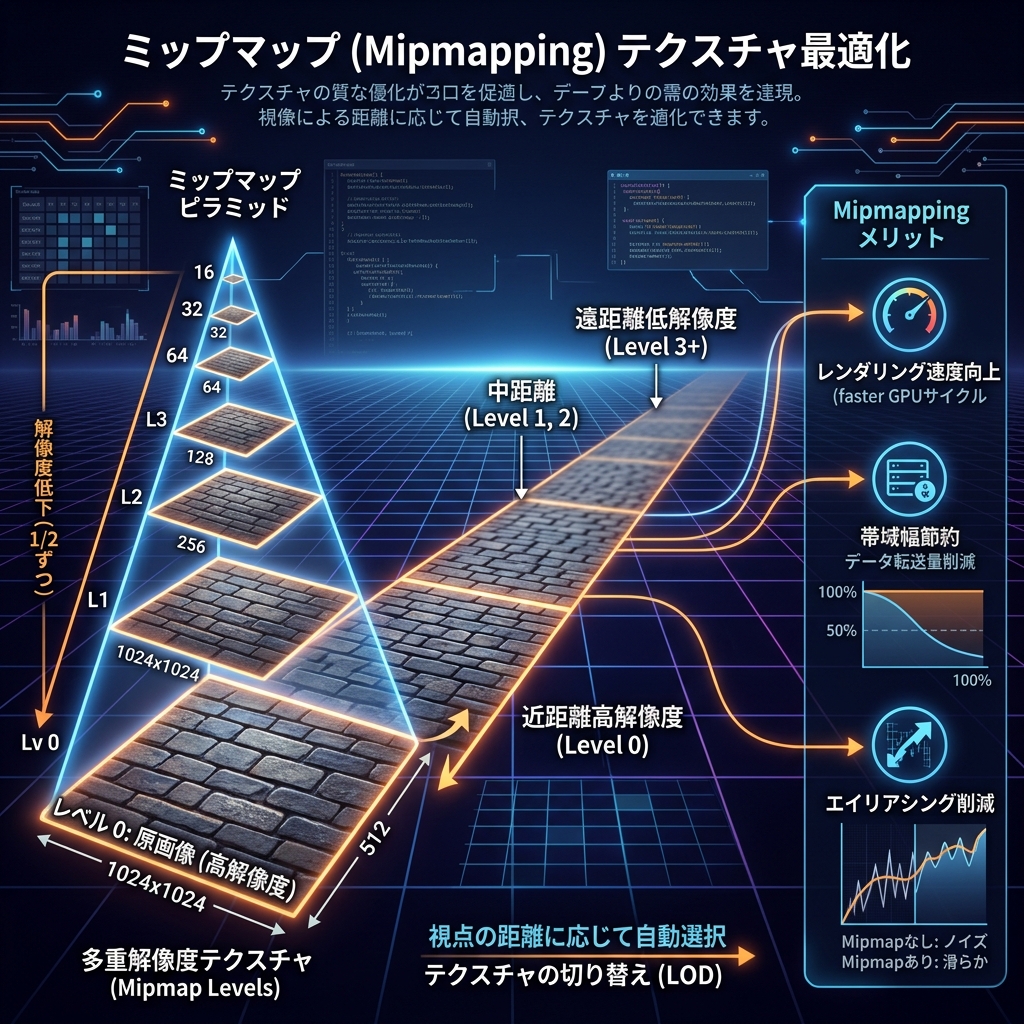
Figure: Infographic that clearly illustrates the basic processing flow and mechanism of Anisotropic Filtering in Japanese.
Detailed mechanism and operating principle
Enable "Anisotropic Filtering" in the target texture settings or the Quality setting in Project Settings (e.g. Forced On or 8x/16x).