Fillrate is a technical term that is extremely important in rendering and optimizing game graphics (technical art). The maximum pixel processing capacity that the GPU can output by filling in colors for pixels on the screen per second, and is an indicator that is directly linked to the screen resolution and the load of overdrawing.
Real-world analogy: The stamina of a painter who paints a gigantic canvas in multiple layers with spray paint within the time limit
Fill rate is the ``filling speed limit'' of how fast the painter (GPU) can fill in colors with spray on a huge canvas (high-resolution screen).'' If the canvas is the size of a postcard (low resolution), you can finish painting with plenty of time, but if the canvas is the size of a school gymnasium wall (4K resolution), the area to be painted will be too large and you won't be able to finish in time. Furthermore, when asked to apply multiple layers of "transparent paint (translucent particles)" on top of that, the painter's stamina (fill rate ability) reaches its limit in an instant, delaying the work.
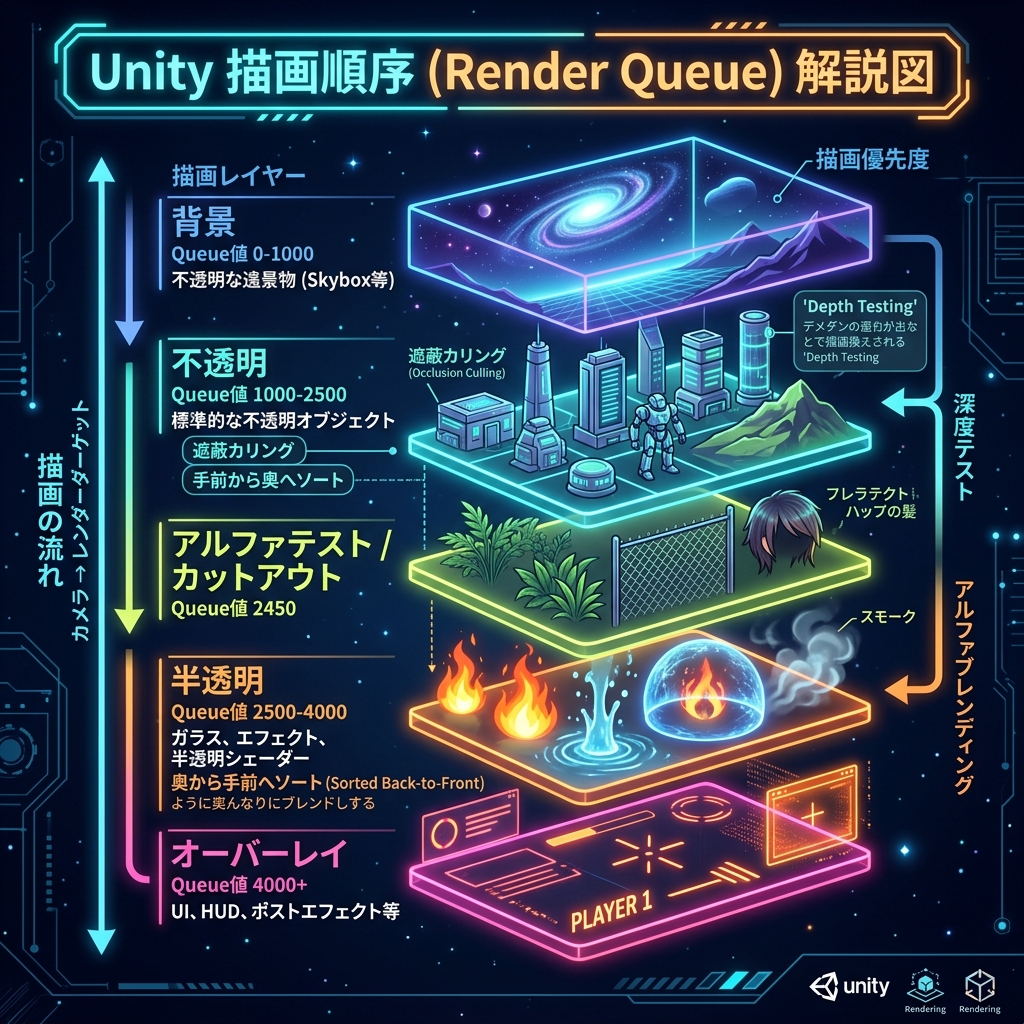
Figure: Infographic that clearly illustrates the basic processing flow and mechanism of Fillrate in Japanese.
Detailed mechanism and operating principle
Thin the number of drawing pixels by reducing the screen resolution scale (Resolution Scale) to 0.8 times, or dramatically reduce the number of overlapping images of translucent effects to lower the fill rate requirements.